JOB HUNTER / FULL-STACK AI ENGINEERING
Job search, connected.
From discovery to follow-up.
A full-stack application that turns a user’s preferences into searched, checked and explained job matches—then keeps application progress in the same workflow.
- MY ROLE
- Full-stack design & implementation
- STACK
- Next.js · FastAPI · PostgreSQL · Docker
- CASE MATERIAL
- Original repository screenshots · Fictional demo data
THE PRODUCT CHALLENGE
Make the search useful.
Keep the next step clear.
A useful job-search tool needs more than a list of postings. It needs to understand the user’s preferences, explain why a job is included, and keep track of what happens next.
I designed and implemented the full stack: the Dashboard, the API and data model, background task handoffs and AI scoring integration. The result connects external data, explicit rules, model assessments and user actions in one application.
THE DASHBOARD & PRODUCT EXPERIENCE
One application. A clear path forward.
Explore the original Dashboard, ranked job matches and a detailed fit explanation. These repository captures use a fictional profile and employers, with simulated scores visibly labelled.
Scroll horizontally to inspect the interface, or open the original image below.
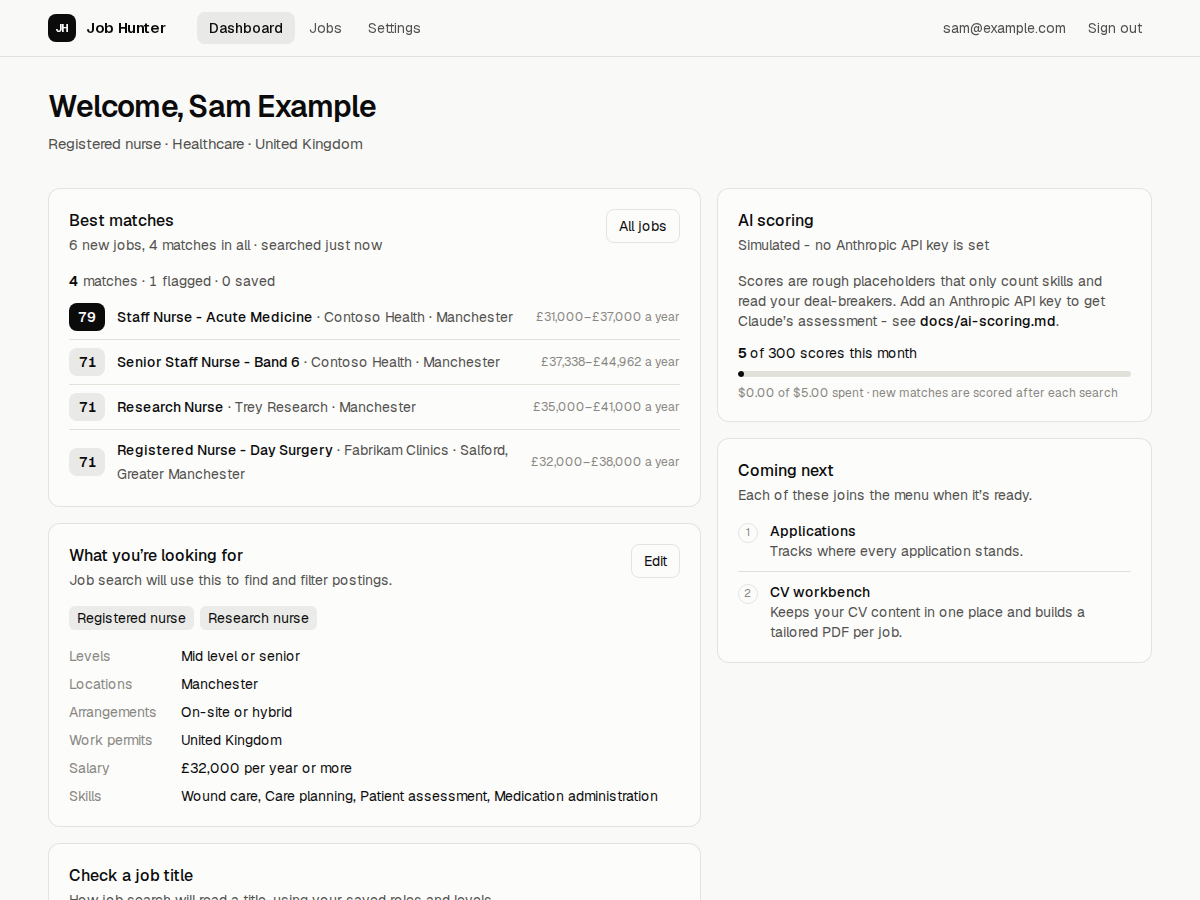
A useful overview of the search.
Ranked matches, profile preferences and scoring usage meet in one dashboard. The fictional profile makes the interface easy to inspect without exposing a real candidate.
Archived repository capture. Its Coming next cards predate the application-tracking and base CV pages now present in the pinned code. Per-job CV tailoring remains future work.
Read every dashboard view and its context
Dashboard
Ranked matches, profile preferences and scoring usage meet in one dashboard. The fictional profile makes the interface easy to inspect without exposing a real candidate.
Archived repository capture. Its Coming next cards predate the application-tracking and base CV pages now present in the pinned code. Per-job CV tailoring remains future work.
Open dashboard imageJob matches
Separate Matches, Flagged and Filtered out views preserve the result of the rule checks. Fit sorting, search and saved state support the next review step.
Fictional employers and built-in sample jobs. Displayed scores are simulated examples, not live-model assessments or hiring-outcome probabilities.
Open job matches imageFit explanation
Four dimensions explain the overall result. Matched requirements, missing skills, rule checks and the original posting stay alongside the score.
The original interface explicitly labels the scorer Simulated. Its placeholder scores illustrate product behaviour; the code also supports a separate Anthropic provider.
Open fit explanation imageInspect the example’s weighted fit score
Staff Nurse - Acute Medicine
Contoso Health · Fictional employer
Example fit score
81 × 30%
Simulated: 3 of the profile's 4 skills appear in the sample posting.
Contribution to the total: 24.3 points.
The four weighted contributions add to 79. The dimensions and weights match the repository’s sample screenshot and healthcare preset. Code calculates the overall score; these simulated values demonstrate the interface, with no live model evaluation.
HOW THE WORK CONNECTS
From a profile to a useful next action.
Each stage has a defined input, output and handoff. Background workers handle search and scoring while the application preserves the user’s choices and the reasoning behind each result.
The search-to-follow-up workflow
Select a stage to follow its input, output and handoff.
02 / SOURCE ADAPTERS
Bring external postings into one format.
The adapters collect data. They do not generate fit opinions or apply for jobs.
- INPUT
- Saved search queries and enabled job-source adapters.
- OUTPUT
- Stored postings, source errors and a company/title/location fingerprint for deduplication.
- HANDOFF
- The worker passes stored jobs to the profile matcher; one source's failure is recorded while the others can continue.
Source-based workflow. Search and scoring use registered worker tasks; matching uses deterministic code. The model sits behind the scoring interface. The diagram describes these responsibilities and data handoffs.
Read the complete workflow
| Stage | Input | Output & handoff |
|---|---|---|
| Define the search | A user's industry, target roles, levels, skills, locations and work preferences. | A structured profile and saved search terms, places and countries. Starting a saved search persists a search run and queues a search task for the worker. |
| Discover & normalise | Saved search queries and enabled job-source adapters. | Stored postings, source errors and a company/title/location fingerprint for deduplication. The worker passes stored jobs to the profile matcher; one source's failure is recorded while the others can continue. |
| Check the rules | A normalised posting, profile constraints and target-role definitions. | Role, level, arrangement, location, work-permit and optional salary checks, each with a status and reason. Any failed check filters the job; otherwise a flag puts it under Flagged. The remaining jobs are matches, with unknown check details retained. |
| Explain the fit | The profile, posting and existing rule checks, plus industry-specific score dimensions and weights. | Validated dimension scores and reasons, quoted requirements, gaps, risks and unknowns, with provider and usage metadata. The score worker stores the assessment. Code calculates the weighted overall score and the web app reads it for ranking and explanation. |
| Review & follow up | Ranked matches and the user's decisions to save or track a job. | Application state, dated next steps and a history of status changes. The dashboard reads best matches, profile, scoring usage and upcoming application steps through the user's API context. |
MY FULL-STACK CONTRIBUTION
The engineering behind the application.
My work covers the product interface, backend, data flow and AI integration. These are the implementation decisions that connect those parts.
A connected product experience
I built the web application around profiles, ranked jobs, explanations and application follow-up. The Dashboard composes the user’s current context into a practical starting point.
Dashboard implementationWork that runs in the background
I connected searches and scoring through persisted worker tasks. Source failures are recorded separately; queue claims, leases and retry states make unfinished work inspectable.
Task queue and recoveryA clear boundary around AI
I integrated structured scoring with rule checks, quote verification, industry weights and provider metadata. The app keeps the model’s assessment and the simulator’s output explicitly labelled.
Scoring contracts and evidenceUser context across the stack
I connected session-aware web requests to authenticated API access and per-user data. Application events preserve status history, while document builds use the background worker and object storage.
Web-to-API integrationSOURCE & SCOPE
A working application, with visible boundaries.
What the implementation covers
Profiles and saved searches, source adapters, deduplication, rule-based matching, structured scoring, application tracking and base CV PDF generation. The scoring provider can use Anthropic or the free local simulator.
Per-job CV tailoring and a hosted subscription product remain future work. Application tracking records user actions; this case does not demonstrate automated job applications.
What you see in this case
The original screenshots preserve their recorded UI state. The archived Dashboard capture predates tracking and CV pages that are present in the pinned implementation. Its scores are simulated product examples.
The workflow and code links were checked against the public repository on 2026-11-04. This portfolio view runs from local assets, with no job-board, email, billing or model calls.
Job Hunter is available under AGPL-3.0 and includes work from ai-job-search by Mads Lorentzen, used under MIT. Project acknowledgements ↗
Inspect the reviewed sourceBRING THIS TO YOUR BUSINESS
Need an AI feature
connected to a real workflow?
I can take it from interface and API design through model integration, background work and a usable application.