Research
What I investigate.
How do models search for solutions, learn from incomplete labels or remember a cue? Follow each question from its experimental design to the limits of its results.
UCL MSc · Computational creativity
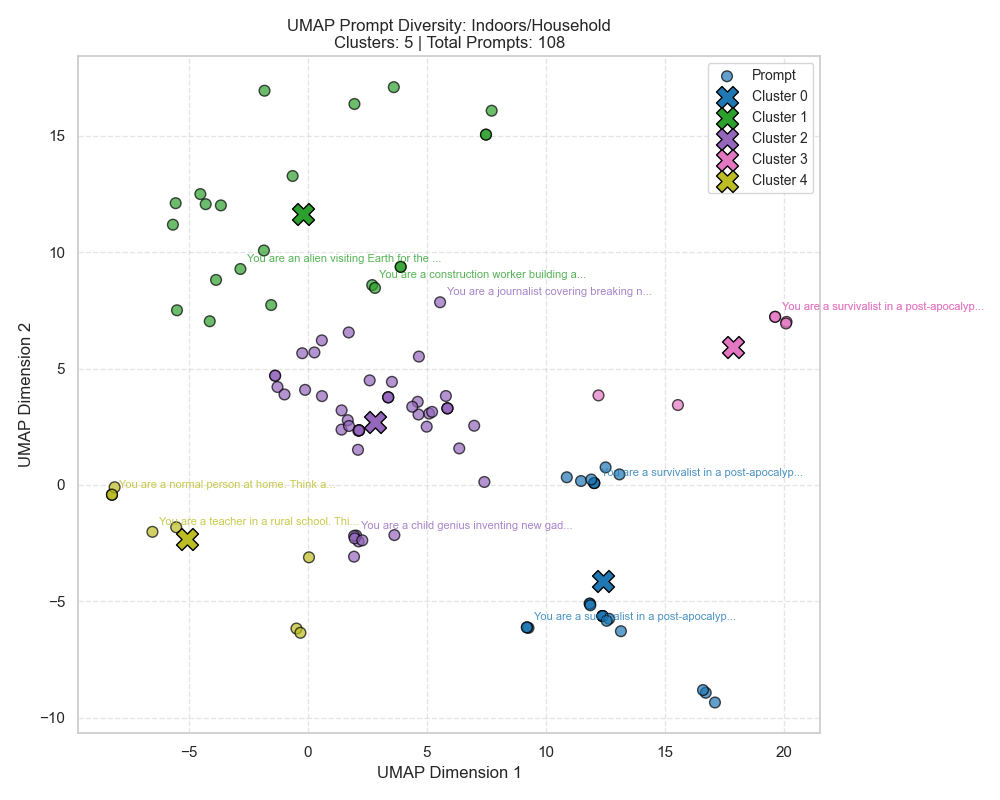
Can evolutionary search uncover a diverse set of useful prompts?
My role Research design, Python framework, experiments and analysis
- Method
- MAP-Elites searches a grammar of prompt styles, retaining candidates across regions of a behavioural map.
- Experimental setup
- Three problem-solving tasks, 20 generations and two baselines. The thesis compares evaluator-rated quality with variation across generated responses.
- Observation
- The Household run gained both quality and variation. On the Outdoors task, increased variation came with lower quality than the no-prompt baseline.
- Limitation
- Three tasks and model-based judgments limit how far the findings generalise.
Computer vision · Group project
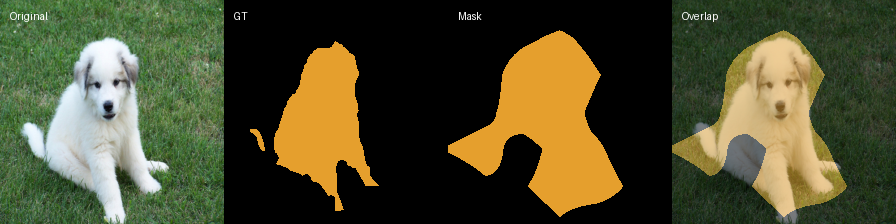
How much can a segmentation model learn from image-level labels?
My role Group project · Data processing, classifier code and evaluation pipeline
- Method
- A breed classifier supplies activation maps. The team converts them to pseudo-labels for foreground segmentation.
- Experimental setup
- The individual report compares CAM and Grad-CAM across three initialisations on Oxford-IIIT Pet, with reference masks for evaluation and a fully supervised reference.
- Observation
- The stronger baseline depended on the initialisation. CAM had higher IoU with scratch and MoCo v2 weights, while Grad-CAM had higher IoU with ImageNet weights.
- Limitation
- Some training settings in the report differ from the current code. The archived tables provide the reported results.
UCL Group 10 · Reinforcement learning
Can an agent remember which goal to choose after the cue disappears?
My role End-to-end project lead · UCL Group 10
- Method
- A learned gate combines a recurrent LSTM state with Transformer memory. The policy uses this mixture to choose an action.
- Experimental setup
- The group compared PALMER, PPO-LSTM and PPO-TrXL on four MiniGrid memory tasks, tracking success rate and episode length.
- Observation
- On the fixed S13 task, PALMER learned quickly early in training. The LSTM baseline completed shorter episodes later in the run.
- Limitation
- The saved results do not establish how reliably the same pattern holds across random seeds.